
Smart Contract Development for Memecoins is a practical decision topic for memecoin builders because it affects trust, launch execution, and how easily users can verify the project. Use this page as an educational checklist, then confirm live platform rules, contract details, and market data before acting.
Introduction
Smart contract development is the technical foundation of every memecoin project. A well-designed contract ensures security, functionality, and investor confidence. According to Chainalysis, smart contract exploits resulted in over $3.8 billion in losses since 2020, making security the paramount concern for any developer.
This guide provides a comprehensive overview of smart contract development for memecoins, covering both Ethereum (Solidity) and Solana (Rust) ecosystems. Whether you're building your first token or optimizing an existing contract, you'll find practical code examples, security patterns, and deployment strategies.
What is a Smart Contract?
A smart contract is a self-executing program stored on a blockchain that runs when predetermined conditions are met. For memecoins, the smart contract defines:
- Token name, symbol, and total supply
- Balance tracking for all holders
- Transfer functionality between addresses
- Optional features like burning, minting, and reflections
- Access control for administrative functions
How Smart Contracts Work
┌─────────────────────────────────────────────────────────────â”
│ SMART CONTRACT LIFECYCLE │
├─────────────────────────────────────────────────────────────┤
│ │
│ 1. WRITE ──▶ 2. COMPILE ──▶ 3. DEPLOY │
│ (Code) (Bytecode) (Blockchain) │
│ │
│ │ │
│ ▼ │
│ │
│ 4. VERIFY ──▶ 5. INTERACT ──▶ 6. UPGRADE │
│ (Source) (Users/DApps) (if upgradeable) │
│ │
└─────────────────────────────────────────────────────────────┘Why Smart Contract Security Matters
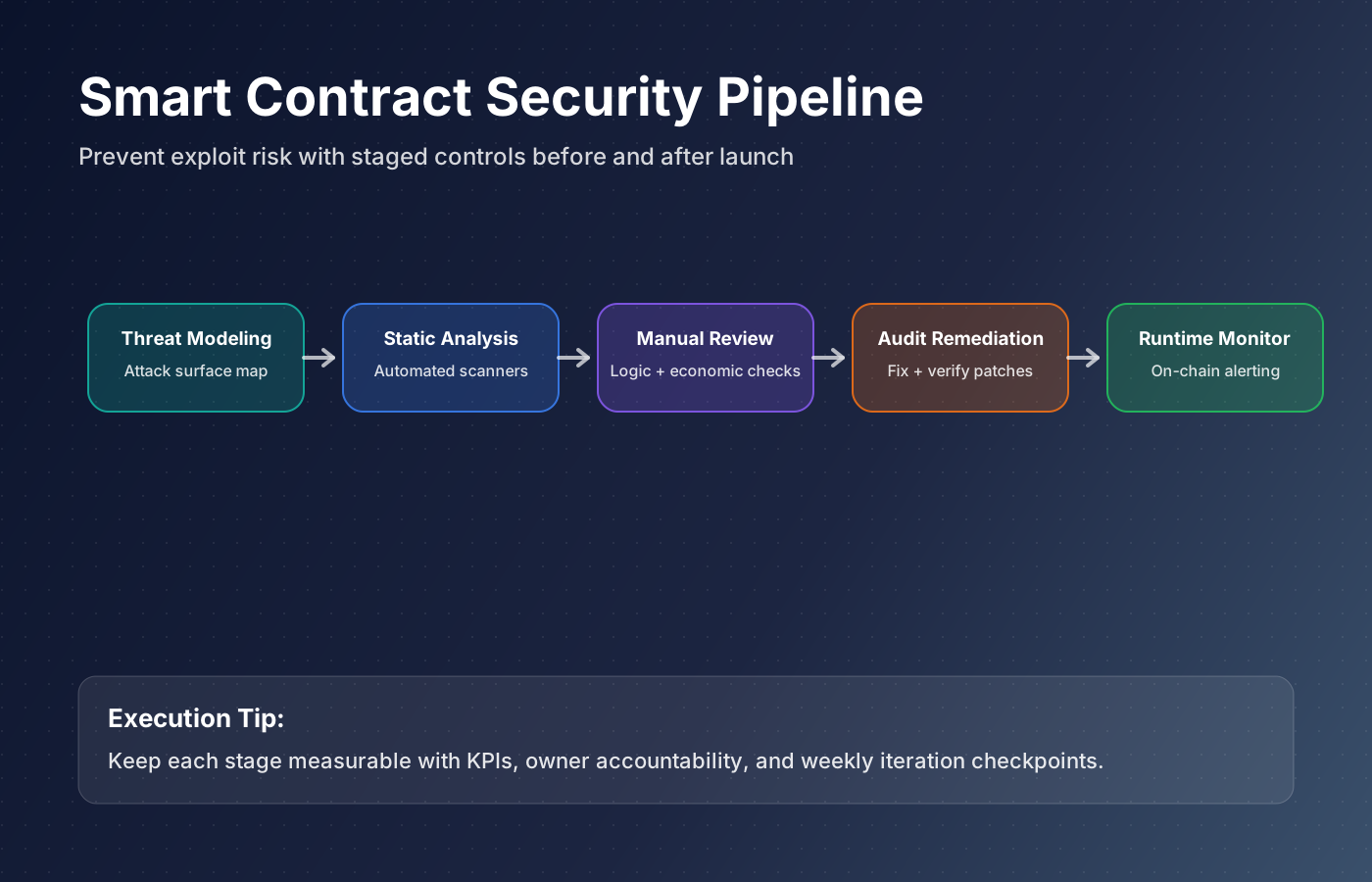
Security vulnerabilities can destroy your project overnight. Common attack vectors include:
| Vulnerability | Description | Prevention |
|---|---|---|
| Reentrancy | Attacker recursively calls functions before state update | Use ReentrancyGuard |
| Integer Overflow | Arithmetic errors in calculations | Use SafeMath (Solidity < 0.8) or built-in checks |
| Flash Loan Attack | Manipulation using borrowed funds | Implement TWAP oracles, limits |
| Honeypot | Tokens that can't be sold | Never implement hidden restrictions |
| Rug Pull | Developers drain liquidity | Lock liquidity, renounce ownership |
Smart Contract Development by Blockchain
Ethereum and EVM-Compatible Chains (Solidity)
Ethereum and its Layer 2 solutions (Arbitrum, Base, Optimism) use Solidity for smart contract development.
Basic ERC-20 Token Contract
// SPDX-License-Identifier: MIT
pragma solidity ^0.8.20;

import "@openzeppelin/contracts/token/ERC20/ERC20.sol";
import "@openzeppelin/contracts/access/Ownable.sol";

contract MemecoinToken is ERC20, Ownable {
    uint8 private constant _decimals = 18;
    uint256 private constant TOTAL_SUPPLY = 1_000_000_000 * 10**18; // 1 billion tokens

    constructor(
        string memory name,
        string memory symbol,
        address initialOwner
    ) ERC20(name, symbol) Ownable(initialOwner) {
        _mint(initialOwner, TOTAL_SUPPLY);
    }

    function decimals() public pure override returns (uint8) {
        return _decimals;
    }

    // Burn function for deflationary mechanics
    function burn(uint256 amount) public {
        _burn(msg.sender, amount);
    }
}
Advanced Features
Tax on Transfers (for marketing/development fund):
contract TaxToken is ERC20, Ownable {
    uint256 public buyTax = 5; // 5%
    uint256 public sellTax = 5; // 5%
    address public taxWallet;

    function _update(
        address from,
        address to,
        uint256 amount
    ) internal override {
        uint256 taxAmount = 0;

        if (from != owner() && to != owner()) {
            if (to == uniswapV2Pair) {
                // Selling
                taxAmount = (amount * sellTax) / 100;
            } else if (from == uniswapV2Pair) {
                // Buying
                taxAmount = (amount * buyTax) / 100;
            }
        }

        if (taxAmount > 0) {
            super._update(from, taxWallet, taxAmount);
            amount -= taxAmount;
        }

        super._update(from, to, amount);
    }
}Solana Token Program (Rust)
Solana uses Rust-based programs that offer significantly lower fees and higher throughput.
Basic SPL Token Creation
On Solana, tokens are created using the SPL Token Program:
# Create a new token
spl-token create-token

# Output: Creating token <TOKEN_ADDRESS>
# Output: Signature: <TRANSACTION_SIGNATURE>

# Create token account
spl-token create-account <TOKEN_ADDRESS>

# Mint tokens
spl-token mint <TOKEN_ADDRESS> 1000000000

# Disable future minting (fixed supply)
spl-token authorize <TOKEN_ADDRESS> mint --disable
Custom Solana Token Program (Advanced)
For custom functionality, you'll need a Rust program:
use anchor_lang::prelude::*;
use anchor_spl::token::{self, Token, TokenAccount, Transfer};

declare_id!("YourProgramId");

#[program]
pub mod memecoin {
    use super::*;

    pub fn initialize(ctx: Context<Initialize>, total_supply: u64) -> Result<()> {
        let mint = &ctx.accounts.mint;
        let authority = &ctx.accounts.authority;

        // Initialize token with supply
        token::mint_to(
            CpiContext::new(
                ctx.accounts.token_program.to_account_info(),
                token::MintTo {
                    mint: mint.to_account_info(),
                    to: ctx.accounts.token_account.to_account_info(),
                    authority: authority.to_account_info(),
                },
            ),
            total_supply,
        )?;

        Ok(())
    }
}

#[derive(Accounts)]
pub struct Initialize<'info> {
    #[account(init, payer = authority, mint::decimals = 9, mint::authority = authority)]
    pub mint: Account<'info, token::Mint>,

    #[account(init, payer = authority, token::mint = mint, token::authority = authority)]
    pub token_account: Account<'info, TokenAccount>,

    #[account(mut)]
    pub authority: Signer<'info>,

    pub token_program: Program<'info, Token>,
    pub system_program: Program<'info, System>,
    pub rent: Sysvar<'info, Rent>,
}
Step-by-Step Development Process
Step 1: Set Up Development Environment
For Solidity (Ethereum/EVM):
# Install Node.js (if not installed)
# Then install development tools
npm install -g hardhat
npm install -g foundry

# Create project
npx hardhat init

# Install OpenZeppelin (recommended security-audited contracts)
npm install @openzeppelin/contracts
For Solana (Rust):
# Install Rust
curl --proto '=https' --tlsv1.2 -sSf https://sh.rustup.rs | sh

# Install Solana CLI
sh -c "$(curl -sSfL https://release.anza.xyz/stable/install)"

# Install Anchor (Solana development framework)
cargo install --git https://github.com/coral-xyz/anchor avm --locked --force
avm install latest
Step 2: Design Your Contract Architecture
Before writing code, plan your contract's features:
Essential Features:
- ✓ Standard transfer functionality
- ✓ Balance tracking
- ✓ Total supply management
- ✓ Ownership control
Optional Features:
- Burn mechanism (deflationary)
- Transaction taxes (marketing/dev fund)
- Reflection rewards (holders earn passively)
- Anti-bot protections
- Max transaction limits
- Automated liquidity generation
Step 3: Write and Test Your Contract
Testing is critical - comprehensive tests catch vulnerabilities before deployment.
// test/MemecoinToken.test.js
const { expect } = require("chai");
const { ethers } = require("hardhat");

describe("MemecoinToken", function () {
  let token, owner, addr1, addr2;

  beforeEach(async function () {
    [owner, addr1, addr2] = await ethers.getSigners();
    const Token = await ethers.getContractFactory("MemecoinToken");
    token = await Token.deploy("Test Meme", "MEME", owner.address);
  });

  describe("Deployment", function () {
    it("Should set the right name and symbol", async function () {
      expect(await token.name()).to.equal("Test Meme");
      expect(await token.symbol()).to.equal("MEME");
    });

    it("Should assign the total supply to the owner", async function () {
      const ownerBalance = await token.balanceOf(owner.address);
      expect(await token.totalSupply()).to.equal(ownerBalance);
    });
  });

  describe("Transactions", function () {
    it("Should transfer tokens between accounts", async function () {
      await token.transfer(addr1.address, 50);
      expect(await token.balanceOf(addr1.address)).to.equal(50);
    });

    it("Should fail if sender doesn't have enough tokens", async function () {
      await expect(
        token.connect(addr1).transfer(owner.address, 1)
      ).to.be.reverted;
    });
  });
});
Run tests:
npx hardhat testStep 4: Audit Your Contract
Professional audits identify vulnerabilities before they can be exploited.
Self-Audit Checklist:
- No reentrancy vulnerabilities
- All arithmetic operations have overflow protection
- Access control is properly implemented
- No unintended fund lockups
- Clear ownership and admin functions
- No hidden minting capabilities
- Liquidity can be locked
- Code is verified on block explorer
Professional Audit Services:
- CertiK ($15,000-$100,000+)
- Hacken ($10,000-$50,000+)
- SlowMist ($8,000-$40,000+)
- Solidity Finance ($5,000-$30,000+)
Step 5: Deploy Your Contract
For Ethereum/Testnets:
// scripts/deploy.js
const hre = require("hardhat");

async function main() {
  const [deployer] = await ethers.getSigners();

  console.log("Deploying contracts with account:", deployer.address);

  const Token = await ethers.getContractFactory("MemecoinToken");
  const token = await Token.deploy(
    "My Memecoin",
    "MEME",
    deployer.address
  );

  await token.waitForDeployment();
  console.log("Token deployed to:", await token.getAddress());
}

main()
  .then(() => process.exit(0))
  .catch((error) => {
    console.error(error);
    process.exit(1);
  });
Deploy command:
# For testnet
npx hardhat run scripts/deploy.js --network sepolia

# For mainnet
npx hardhat run scripts/deploy.js --network mainnet
Step 6: Verify Your Contract
Contract verification allows users to read your code on block explorers:
# Using Hardhat
npx hardhat verify --network mainnet <CONTRACT_ADDRESS> "My Memecoin" "MEME" "<OWNER_ADDRESS>"

# Using Etherscan
# Go to your contract on Etherscan > Code > Verify and Publish
Step 7: Add Liquidity
After deployment, add liquidity to DEXs:
For Ethereum (Uniswap):
1. Go to app.uniswap.org
2. Connect wallet with token supply
3. Select your token and ETH (or other paired token)
4. Add liquidity with desired amounts
5. Confirm transaction and receive LP tokens
For Solana (Raydium):
1. Go to raydium.io
2. Navigate to Create Pool
3. Select your token and SOL
4. Set initial price and liquidity amounts
5. Confirm and create pool
Security Best Practices
1. Use Audited Libraries
Always use battle-tested libraries like OpenZeppelin:
// Good - using audited contracts
import "@openzeppelin/contracts/token/ERC20/ERC20.sol";
import "@openzeppelin/contracts/security/ReentrancyGuard.sol";

// Avoid - writing from scratch
// contract MyToken { ... } // More prone to errors
2. Implement Access Control
import "@openzeppelin/contracts/access/Ownable.sol";
import "@openzeppelin/contracts/access/AccessControl.sol";

contract SecureToken is ERC20, Ownable, AccessControl {
    bytes32 public constant MINTER_ROLE = keccak256("MINTER_ROLE");

    constructor() ERC20("Secure Meme", "SMEME") {
        _grantRole(DEFAULT_ADMIN_ROLE, msg.sender);
        _grantRole(MINTER_ROLE, msg.sender);
    }

    function mint(address to, uint256 amount) public onlyRole(MINTER_ROLE) {
        _mint(to, amount);
    }
}
3. Prevent Reentrancy Attacks
import "@openzeppelin/contracts/security/ReentrancyGuard.sol";

contract SecureWithdraw is ReentrancyGuard {
    function withdraw() public nonReentrant {
        // Withdrawal logic
    }
}
4. Use SafeERC20 for Token Operations
import "@openzeppelin/contracts/token/ERC20/utils/SafeERC20.sol";

contract TokenHandler {
    using SafeERC20 for IERC20;

    function safeTransfer(IERC20 token, address to, uint256 amount) internal {
        token.safeTransfer(to, amount);
    }
}
5. Implement Emergency Stop (Circuit Breaker)
import "@openzeppelin/contracts/security/Pausable.sol";

contract PausableToken is ERC20, Pausable, Ownable {
    function pause() public onlyOwner {
        _pause();
    }

    function unpause() public onlyOwner {
        _unpause();
    }

    function _update(
        address from,
        address to,
        uint256 amount
    ) internal override whenNotPaused {
        super._update(from, to, amount);
    }
}
Common Mistakes to Avoid
- Copying unverified contracts: Always audit any code you reuse
- Skipping tests: Comprehensive tests catch many common vulnerabilities
- Ignoring gas optimization: High gas costs discourage users
- Hidden owner functions: Transparency is essential for trust
- Unlocked liquidity: Always lock or burn LP tokens
- No max supply: Unlimited minting is a red flag
- Complex tax systems: Overly complex mechanics raise suspicion
- Forgetting to verify: Unverified contracts appear suspicious
Gas Optimization Tips
Optimizing gas costs improves user experience:
| Optimization | Gas Saved | Implementation |
|---|---|---|
Use uint256 instead of smaller types | 5-10% | Native EVM word size |
| Cache array length in loops | 20-30% | Store length in variable |
Use calldata vs memory for reads | 15-25% | Function parameters |
| Pack storage variables | 50-80% | Group smaller types |
| Use events for historical data | 90%+ | Events cost less than storage |
Tools and Resources
| Tool | Purpose | Link |
|---|---|---|
| Hardhat | Development environment | hardhat.org |
| Foundry | Fast development toolkit | getfoundry.sh |
| OpenZeppelin | Secure contract library | openzeppelin.com |
| Remix IDE | Browser-based IDE | remix.ethereum.org |
| Solana Playground | Solana IDE | beta.solpg.io |
| Slither | Static analysis | github.com/crytic/slither |
| Etherscan | Contract verification | etherscan.io |
| Token Sniffer | Scam detection | tokensniffer.com |
Pro Tips
Summary
Smart contract development for memecoins requires a balance of technical expertise, security awareness, and practical implementation skills. By following this guide and leveraging established tools and libraries, you can create secure, efficient contracts that instill investor confidence.
Key takeaways:
- Use audited libraries like OpenZeppelin
- Implement comprehensive tests
- Get professional audits for serious projects
- Always lock liquidity and verify contracts
- Maintain transparency with your community
Ready to develop your memecoin contract? Explore MemecoinLab's services for professional development support, or use our MEMELAB tools for AI-powered contract descriptions.